


 Brian Dillon
A collection of Irish writer Mary Lavin’s most skillful, subtle, and furious short stories, selected and introduced by Colm Tóibín.
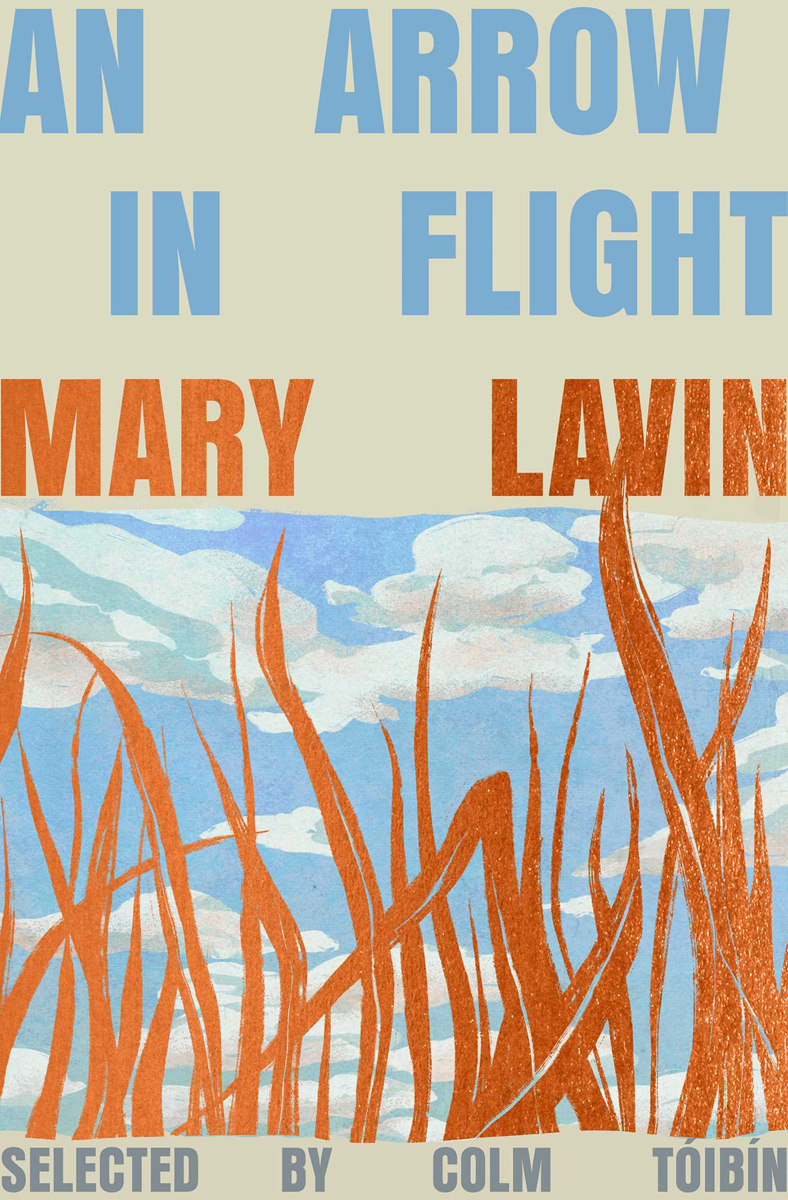
An Arrow in Flight: Selected Stories, by Mary Lavin,
Scribner, 399 pages, $20
• • •
Of course, one doesn’t actually read the reactionary London Times, but a recent headline from its books pages made my heart sink in familiar style. On Mary Lavin: “A ‘quiet genius’—the Irish female writer who’s finally in the spotlight.” God help us! It seems that no matter how brilliant, celebrated, or professionally successful a female writer of decades or centuries past, there will always be those for whom she is discovered at last. Perhaps it was easy for the English to miss out on Lavin, one of those Irish authors who maintained a literary double life: quite well-known at home for her short story collections (also, in Lavin’s case, a renowned salon at her Dublin house) but making her living, and reaching a very different readership, as a regular contributor to the New Yorker. Like other Irish masters of that magazine’s short-story slot—Frank O’Connor, William Trevor, nowadays Claire Keegan—Lavin worked in a realist mode, and, like them, she is a more peculiar and fearsome writer than reputation, or the New Yorker’s polished tastes, might imply. An Arrow in Flight collects some of her most skillful, subtle, and furious stories; the selection has been made by Colm Tóibín, who also introduces the book.
Lavin was born in 1912 to fairly prosperous Irish immigrants in Massachusetts, but lived back in Ireland from the age of nine; she arrived old enough to cast an outsider’s eye on people, landscape, and customs. She studied English and French in Dublin, and in the late 1930s began a PhD on Virginia Woolf. But one day, in a bank, she met an older woman who asked about her studies, and when Lavin mentioned Woolf, she said: “I had tea with her yesterday.” Suddenly Woolf sprang to mind as a real person, not an academic abstraction. As Lavin recalled in a 1992 documentary, also titled An Arrow in Flight, “I said: God, what is Virginia Woolf doing? She’s certainly not writing a thesis.” Lavin wrote her first story on the back of a draft of the dissertation she soon abandoned. Her debut collection, Tales from Bective Bridge, appeared in 1942; many more, and several novels, followed. In 1954, Lavin’s husband died. Some of her best stories from that point on are about the ambiguous condition of widowhood, its confusion of grief, hope, suspicion, and pity. Just as frequently, mourning reveals some quirk of character that may have been lurking all along.
Consider, for example, “In a Café,” from 1960. Initially, it is a thorny first encounter between two women who have lost their husbands: Mary is older and, in some ways, used to her state—she can no longer easily picture what her husband looked like—while Maudie is newly widowed after only a year of marriage. Mary arrives early in a modest Dublin café run by students from the local art college, and spots a young painter sitting nearby. “Would Maudie, too, be in black with touches of white? Two widows! It was like two magpies: one for sorrow, two for joy.” When they meet, Mary cannot help cruelly expressing her impatience with young Maudie’s fresh state of grief: “In spite of herself, she felt she was being drawn into complicity with her. She drew back resolutely.” Mary is now distracted by the painter, with whom she strikes up a conversation, possibly even a flirtation. “In a Café” turns from a pointed study of overlapping but antagonistic experiences and attitudes to a more daring and profound reflection on recklessness, resignation, and imagination: “What use was it to have lived the past, if behind us it fell away so sheer?” Some of the best of Lavin’s stories contain such moments of escalation, sometimes brutal: near the end of “A Memory,” which is mostly about a self-limiting relationship, the uptight male protagonist finds himself hurtling at night to a fateful conclusion, all because of a silly middle-aged huff and a mix-up over bus stops.
Like her close contemporary Maeve Brennan—another great Irish writer for the New Yorker—Lavin’s prose can give up surface elegance for something weirder and more indelible: a pair of polished shoes “shining like laurel leaves” will be with me forever. Occasionally she is self-conscious as well as surprising at the level of structure. “A Story with a Pattern” is framed by the author-narrator’s meeting with a tedious man at a party: “He was evidently one of those men in whom an eagerness for knowledge had developed only when it was too late for schooling to supply it.” Of course, he wants to advise her smugly on how to tell a good story, but then embarks himself on a tale of marital misunderstanding that would put to shame any nineteenth-century Russian. Or would it? The original narrator doubts the very symmetries of storytelling: “Life in general isn’t rounded off like that at the edges; out into neat shapes. Life is chaotic; its events are unrelated; its . . .” “There you go again!” says the obnoxious fellow.
In his introduction, Tóibín follows critical convention about Lavin and writes that her concerns as an Irish writer are with complications of the heart rather than matter of national import. This is true, I suppose (and I assume Tóibín slyly knows it), if you don’t consider the private and public subjugation of so many Irish women a topic as important as the aftermath of revolution or the draining effects of emigration. Among the more shocking tales in An Arrow in Flight is “Asigh” (1959), in which an authoritarian rural father has permanently maimed his daughter for the sin of speaking to an unsuitable young man. But in subject matter, the most extraordinary piece is “Sarah”—the pregnant character of the title, already an unmarried mother, is thrown out of the family home by her brothers, and dies in a ditch with her newborn child. I read “Sarah” here for the first time and assumed it had been written in the 1980s, a decade when such deaths loomed large in Irish consciousness and began to shake belief in Irish patriarchy. In fact, “Sarah” was published in the early 1940s—Lavin had long been saying what much of Ireland was too vicious or fearful to admit.
Brian Dillon’s memoir Ambivalence will be published in September by New York Review Books. He is working on Charisma, a novel.