


 Melissa Anderson
Two tales of coming out: new films by Hafsia Herzi and Anna Cazenave Cambet are a study in contrasting experiences of self-reckoning and sapphic sexuality.

Nadia Melliti as Fatima in The Little Sister. Courtesy Film at Lincoln Center. © June Films, Katuh Studio, ARTE France, and mk2 Films.
The Little Sister, written and directed by Hafsia Herzi, screening March 7 and 10, 2026, Film at Lincoln Center, New York City
Love Me Tender, written and directed by Anna Cazenave Cambet, screening March 7 and 12, 2026, Film at Lincoln Center
• • •
Two adaptations of autofiction first published in 2020, each set in the greater Paris area and each a tale of a woman’s coming out, screen this week as part of the thirty-first edition of “Rendez-Vous with French Cinema,” Film at Lincoln Center’s annual showcase of Gallic movies. Beyond their superficial connections, Hafsia Herzi’s The Little Sister (one of eight films in the “Rendez-Vous” lineup to have secured US distribution to date) and Anna Cazenave Cambet’s Love Me Tender are a study in contrasts. The former focuses on a teenager, the daughter of Algerian immigrants living in a banlieue tower block, trying to reconcile her Muslim faith with her sexuality. The latter centers on a woman in early middle age, the scion of a prestigious family, who gave up bourgeois comforts—namely her law career and heteronormative life with her husband and young son in the posh sixth arrondissement—to devote herself solely to writing in cramped garrets and borrowed flats and becoming a sapphic lothario. The protagonist of The Little Sister is played by a first-time performer, that of Love Me Tender by a veteran actress—casting that impairs, if not to the same extent, each project.
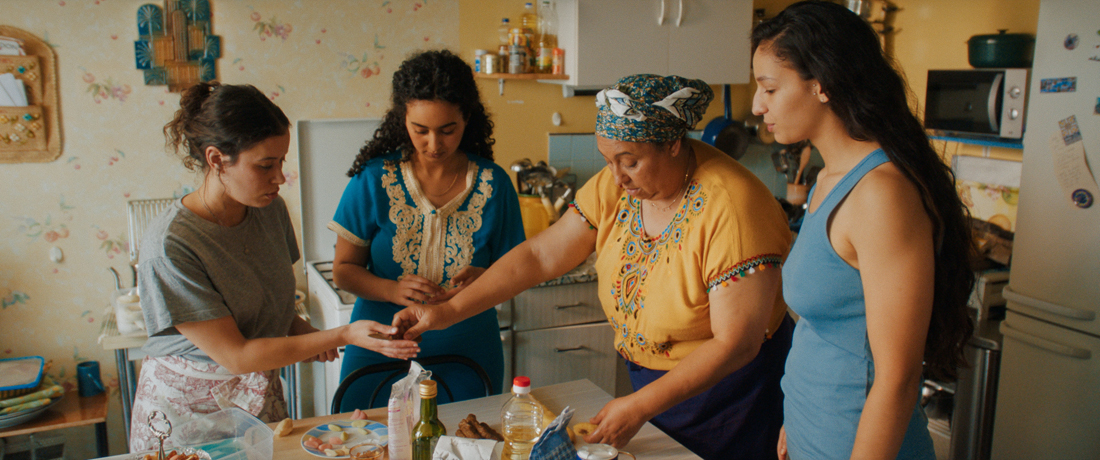
Melissa Guers as Nour, Rita Benmannana as Dounia, Amina Ben Mohamed as Kamar, and Nadia Melliti as Fatima in The Little Sister. Courtesy Film at Lincoln Center. © June Films, Katuh Studio, ARTE France, and mk2 Films.
Herzi began her film career as an actress, making a strong on-screen debut as the most resourceful character in Abdellatif Kechiche’s 2007 ensemble piece The Secret of the Grain. Her third feature as director, The Little Sister is based on Fatima Daas’s book of the same name (the original title of both is La petite dernière, literally “The Little Last One”; I have not read the 2021 English translation). As Herzi’s film opens, Fatima (Nadia Melliti), dressed in a jilbab, is performing ablutions before her daybreak prayers. Her religious attire is soon swapped out for her everyday duds: loose Adidas athleisure wear and cap. At home, she congenially bickers with her two older sisters and enjoys the attention of her doting, always-cooking mother; her kind if withdrawn father prefers the TV to this all-female rabble. At school, she excels in her literature class, dutifully prepares for her bac, and stands out as the only young woman in a clique of bros. When one of these loutish guys calls a flamboyant classmate a faggot, he retorts that the fille in their crowd is a lesbian—an allegation that deeply closeted Fatima responds to with fury and fists.

Park Ji-min as Ji-Na Kim and Nadia Melliti as Fatima in The Little Sister. Courtesy Film at Lincoln Center. © June Films, Katuh Studio, ARTE France, and mk2 Films.
But the episode shakes something loose in her. While still maintaining a façade of heterosexuality—meeting her “boyfriend,” a fellow Muslim, in the corridors of her building and nodding along while he talks of “making things official”—Fatima goes on the apps under a pseudonym to meet women. At first her dates are fact-finding missions—one older woman details with great relish what scissoring and 69 are—but soon enough, she’s hanging out in lez bars in the Marais. She clicks with Ji-Na (Park Ji-min), a nurse; their long, languorous, slurpy kissing on Ji-Na’s couch conveys real heat, a lusty connection all too rare in current on-screen couplings of any sexuality. But after their relationship ends, an episode that nearly coincides with Fatima’s first day at university, The Little Sister falters. The relaxed pace of the heroine’s self-discovery has now been supplanted by shorter, more frenetic and disjointed scenes—Fatima’s increasingly debauched evenings, a dream sequence, a pained conversation with an imam—that don’t suggest the whirlwind nature of her bifurcated life so much as a film losing its bearings. Fatima, a character rarely seen in cinema, begins to recede as a complex, curious, and overwhelmed person, shifting to someone depicted in rushed fragments. Some of this irregularity, especially in The Little Sister’s second half, can be attributed to Melliti’s uneven performance. Often her untutored acting style felicitously highlights the fragility of Fatima’s butch, tomboyish bravado; at other times, Melliti’s lack of acting experience simply translates as awkward stiffness before the camera.
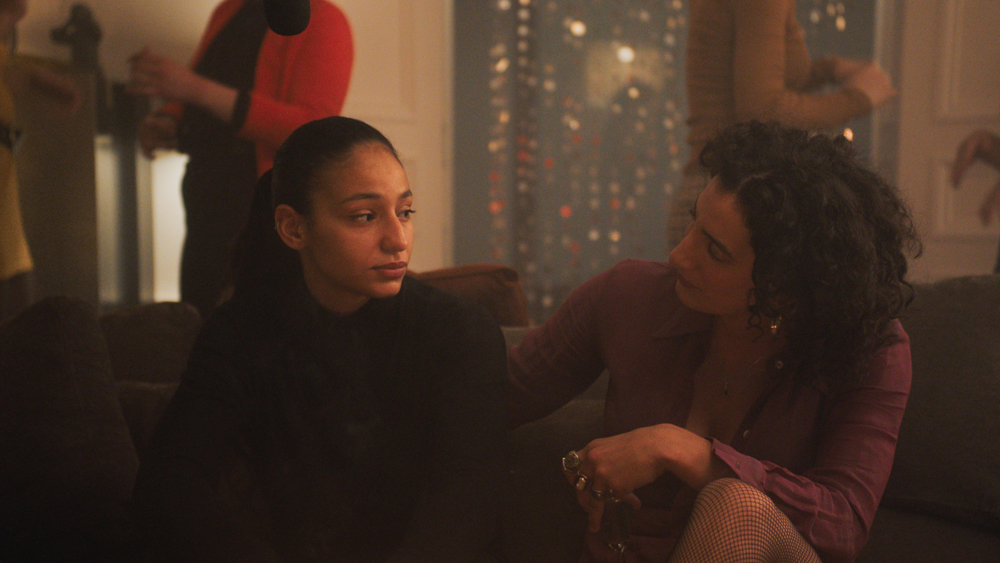
Nadia Melliti as Fatima and Mouna Soualem as Cassandra in The Little Sister. Courtesy Film at Lincoln Center. © June Films, Katuh Studio, ARTE France, and mk2 Films.
Conversely, Love Me Tender suffers from having a lead who is much better-known but all wrong for the part. Vicky Krieps—whose breakthrough performance was in Paul Thomas Anderson’s 2017 haute-couture gothic, Phantom Thread, and who has since starred in films by European auteurs as well as in movies by M. Night Shyamalan and Jim Jarmusch—plays protagonist Clémence Delcourt. Her initials are the same as those of Constance Debré, the author of the eponymous source text (issued in the US in 2022 and translated by Holly James), who uses only “I” to refer to herself in this volume, the second installment of an autofictional trilogy. The cover of Debré’s book, which I’ve read twice, features a black-and-white photo of the writer in profile: she is a severe figure of lines and angles, dourly looking downward, her hair shorn to a few millimeters of stubble, a stick-and-poke, all-caps tattoo on her neck declaring PLUTOT CREVER (“I’d rather die”).

Vicky Krieps as Clémence Delcourt and Viggo Ferreira-Redier as Paul Lévêque in Love Me Tender. Courtesy Film at Lincoln Center.
Debré also brags of the tattoo written across her stomach that reads “Son of a Bitch.” Krieps’s character has one prominent indelible design on her flesh: the head of a friendly-looking dog, inked on her shoulder blade. That’s but one minor example of the film’s tendency to soften its Debré surrogate; a more significant disconnect emerges from the actress portraying her. Even when thoroughly deglammed, Krieps, possessed of a peaches-and-cream complexion and radiant eyes, emits an undimmable sunniness. There is none of Debré’s stylized, menacing mien, her outward appearance a crucial part of her radical reinvention.

Vicky Krieps as Clémence Delcourt and Antoine Reinartz as Laurent Lévêque in Love Me Tender. Courtesy Film at Lincoln Center.
As with Debré’s book, Cambet’s film tracks the rituals of its heroine’s pared-down existence. Her life is both monastic and disciplined (Clémence swims two kilometers every day, often just after dawn, and writes during any free moment; swaths of the source novel are repurposed as Clémence’s voice-over) and satyric (the movie opens with Clémence making a woman she’s just cruised at the pool cum in a changing room). Soon, though, her day-to-day will be upended by the bureaucratic and legal labyrinth she must navigate in order to have visitation rights with her son, Paul (Viggo Ferreira-Redier), after her ex-husband, Laurent (Antoine Reinartz), deems her an unfit parent and demands sole custody when she tells him of her same-sexing.

Vicky Krieps as Clémence Delcourt and Monia Chokri as Sarah in Love Me Tender. Courtesy Film at Lincoln Center.
Whereas Debré recounts all of this—the front crawl, the keystrokes, the “girls, girls, more girls,” the soul-crushing battles to see Paul—with unadorned, unsentimental, hurtling prose, Cambet’s movie plods along, several scenes unnecessarily distended. It presents Clémence as something of a dyke Don Juan but lingers too long on certain of her bedmates, not really giving an acute sense of Debré’s compulsive sex life. Debré’s writing is as astringent as her visage; she insists that renouncing the privileges she once had as a heterosexual white-collar professional in a snug nuclear family should have no bearing on her competence or her claims as a mother. The bracing causticity of Debré’s self-reckoning has been diluted and devitalized in Cambet’s version, in which the author’s avatar is rendered as a rosy-cheeked, innocuous seducer. Krieps gives a polished performance that further smooths the original’s serrated edges. Melliti’s rougher, rawer one makes the more lasting impression.
Melissa Anderson is the film editor of 4Columns and the author of a monograph on David Lynch’s Inland Empire from Fireflies Press. A collection of her film criticism, The Hunger, is now available from Film Desk Books.