


 Aruna D’Souza
The first US exhibition of Édouard Glissant’s personal art collection is fertile landscape for thinking through the poetics of relation.
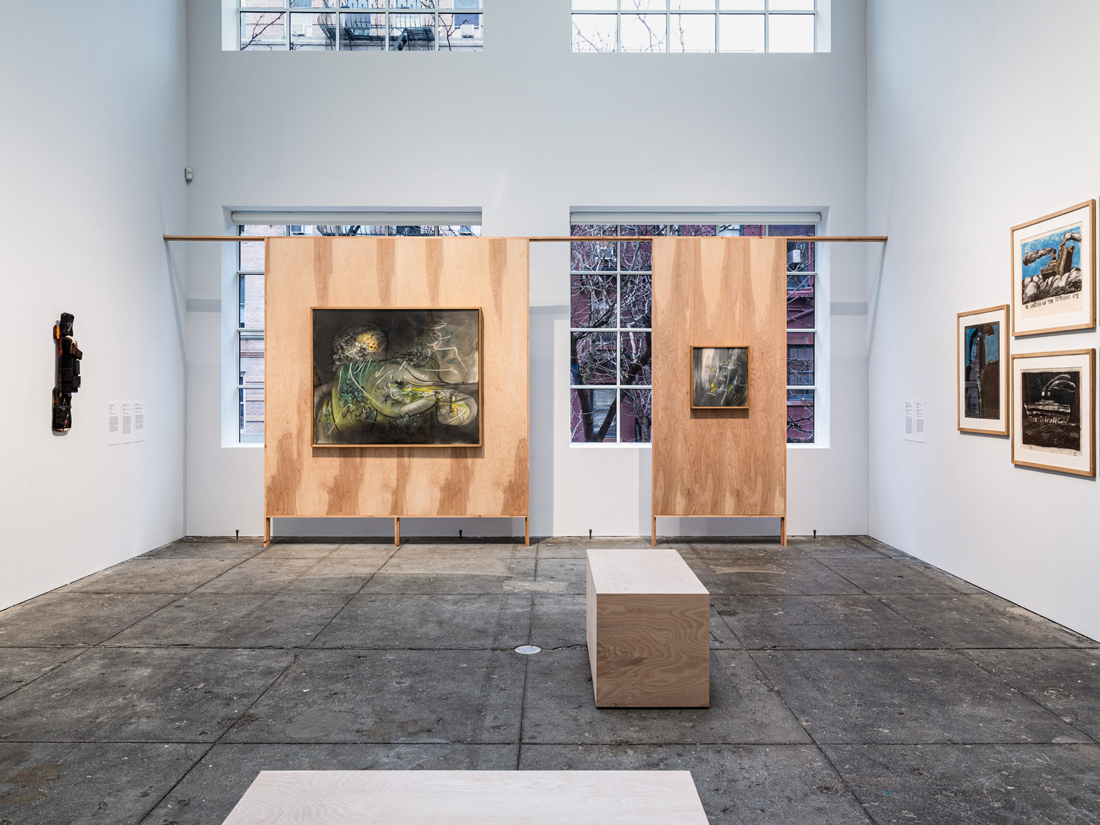
The Earth, the Fire, the Water, and the Winds: For a Museum of Errantry with Édouard Glissant, installation view. Courtesy CARA. Photo: Kris Graves.
The Earth, the Fire, the Water, and the Winds: For a Museum of Errantry with Édouard Glissant, curated by Manuela Moscoso with Marian Chudnovsky, Paulo Miyada, and Ana Roman, Center for Art, Research and Alliances (CARA), 225 West Thirteenth Street, New York City,
through May 10, 2026
• • •
Has anyone had as much influence on the art world in recent memory as Édouard Glissant? The Martinican poet and philosopher’s ideas surfaced among contemporary artists and curators in the 1990s—parallel to the rise of global capitalism and its attendant movements of people and commodities over lately (if inconsistently) porous borders; parallel to the expansion of the international art biennial; parallel to the opportunities and crises that this new world order delivered. And why not? He theorized not just postcolonial or decolonial but also counter-colonial forms of relation, in which history’s violences and injustices frame novel modes of encounter where individual sovereignty is paramount and only ensured by both a recognition of and a respect for diversity.
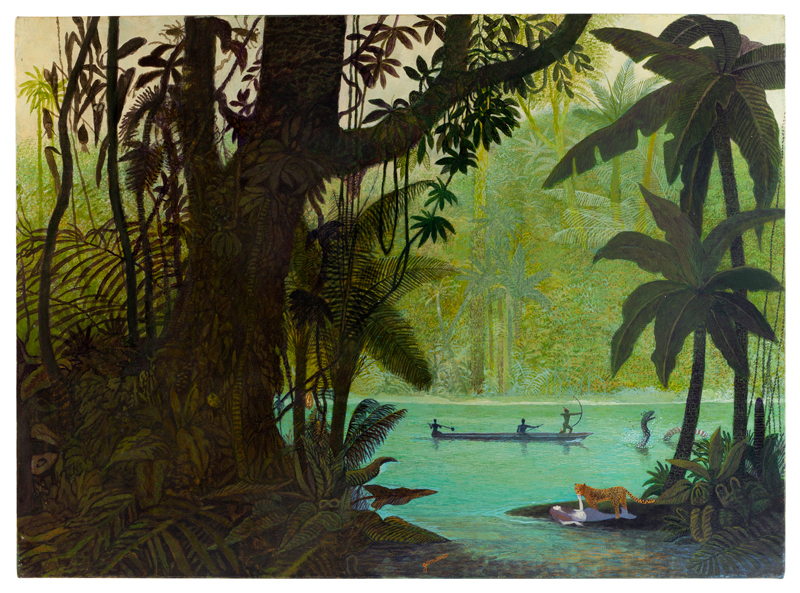
José Gamarra, L’inaccessible . . . (The inaccessible . . . ), 1986–87. Édouard Glissant’s personal collection. Courtesy Mémorial ACTe.
He was saying what cultural producers needed to hear in the face of the homogenization that neoliberalism sought to impose, and, in the West, an art world grappling with an accelerated multiculturalism. It has remained no less relevant in the decades since, with rising global fascism and waves of forced migration. Glissant spoke of the archipelago (collectives made of discrete parts that function without losing their distinctiveness), opacity (the right to not translate oneself into the terms of the dominant power or discourse), creolization (the unpredictable melding of cultures, histories, landscapes, and temporalities that creates new, and unfixed, formations; a fundamental instrument of world-building)—and now we do, too.
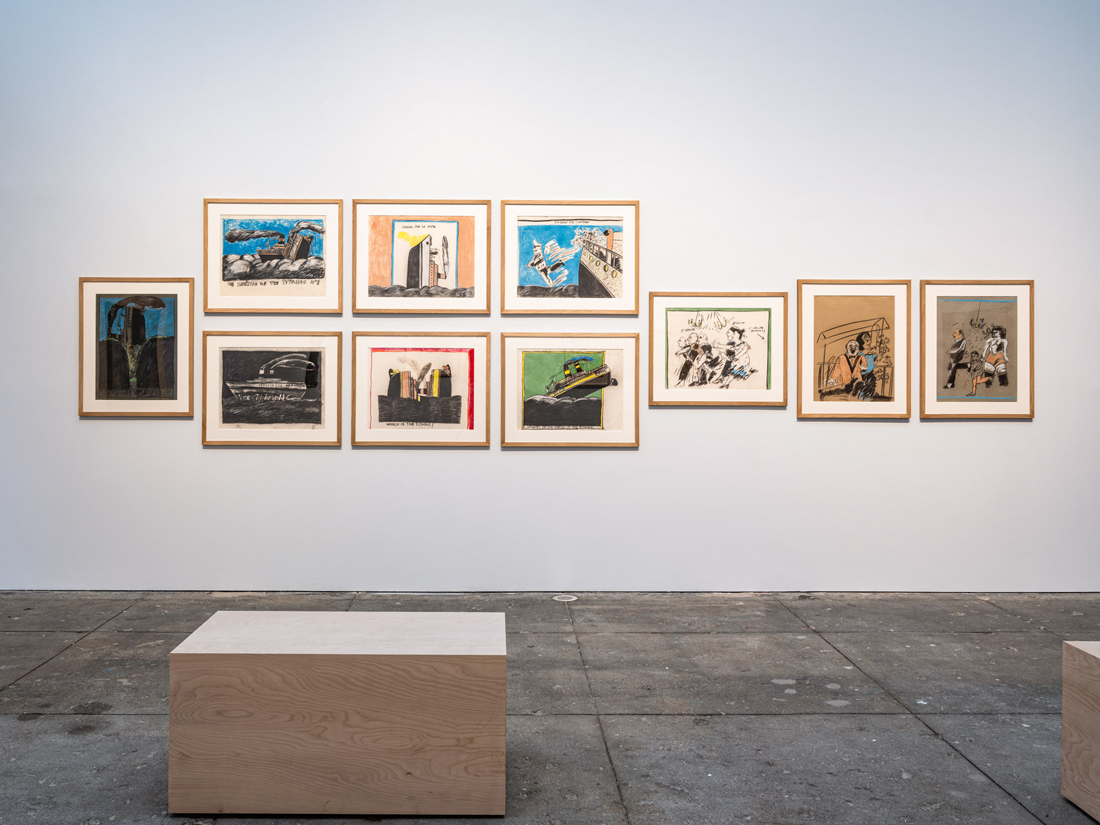
The Earth, the Fire, the Water, and the Winds: For a Museum of Errantry with Édouard Glissant, installation view. Courtesy CARA. Photo: Kris Graves.
Glissant began developing his theory of Caribbean culture in the 1950s, in dialogue with intellectuals including Aimé Césaire, Frantz Fanon, and Léon Damas. He saw that culture as inextricably tied to other parts of the world, because it bore the traces of colonialism, the Middle Passage, the plantation economy, the movements of indentured labor, Indigenous pasts and presents, and so on. Because it contained the whole world in its ambit, Caribbean culture, in Glissant’s view, was neither an anthropological fact nor a historical phenomenon but a method—a way of imagining solidarity across chasms of difference. It is not surprising that art played a role in his thinking. He wrote about painting and sculpture extensively, especially that of the international roster of artists who gathered at the Galerie de Dragon in Paris (1955–1995). He amassed a significant collection during his peripatetic life (he lived in Paris and the US in addition to his time in the islands). He was invited by former French president Jacques Chirac to envision a center dedicated to the memory of slavery and its abolition—a vision that would inform the establishment of Mémorial ACTe in Guadeloupe in 2015—and he dreamt of creating another: the Martinican Museum of the Arts of the Americas, a project that remained unfinished at the time of his death in 2011.
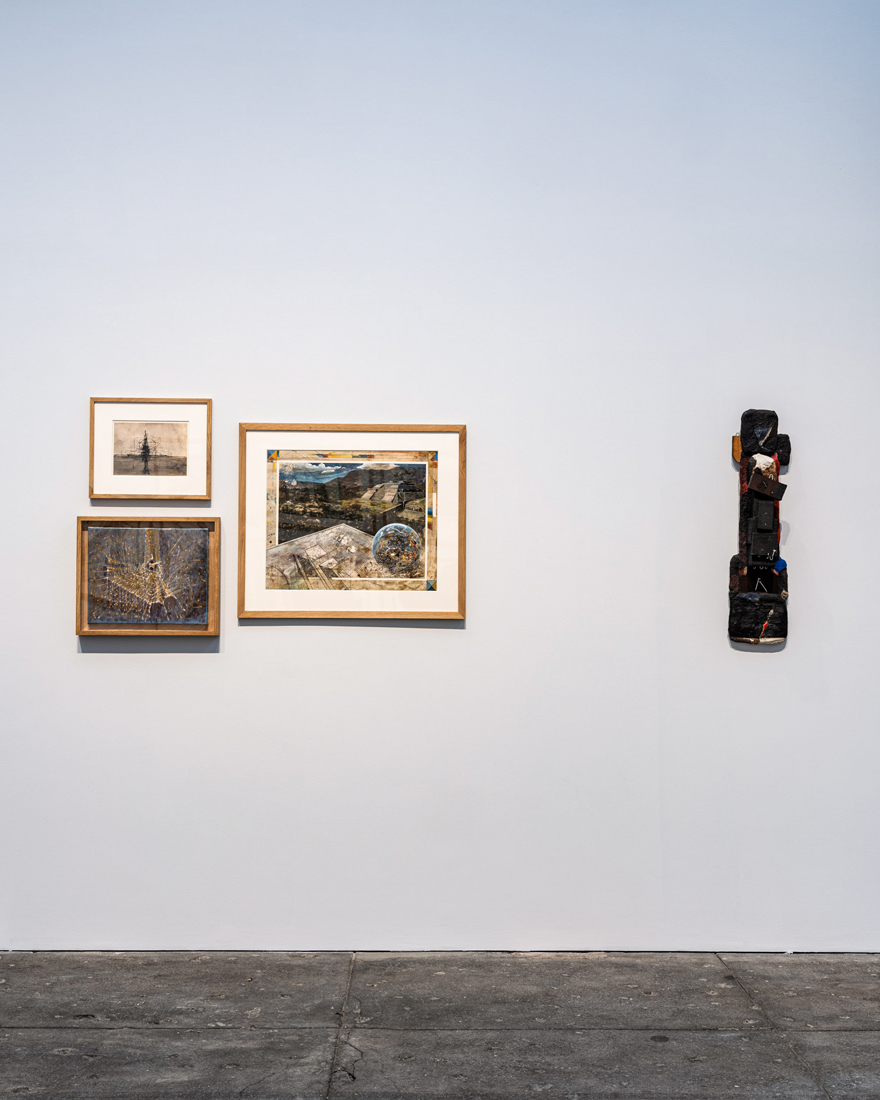
The Earth, the Fire, the Water, and the Winds: For a Museum of Errantry with Édouard Glissant, installation view. Courtesy CARA. Photo: Kris Graves. Pictured, center left: Pancho Quilici, Untitled, 1985.
The Earth, the Fire, the Water, and the Winds: For A Museum of Errantry with Édouard Glissant, now on view at the Center for Art, Research and Alliances (CARA), is the first US exhibition of his personal art collection. But it is so much more than that—it offers insight into Glissant’s understanding of how artworks relate to each other, and how we might relate to them, and to one another. The show originated in São Paulo, at the Instituto Tomie Ohtake, where it was significantly larger, and, in addition to pieces Glissant encountered in his lifetime, included the work of several contemporary artists impacted by his writings. But to call the New York iteration a truncated version would be to misunderstand what a “museum of errantry” might be: not encyclopedic, not chronological, not something that promotes a fixed vision of culture, not a monument to a past or a crystallization of a present or future, but a constantly shifting archive of encounters, relationships, of conversations, of communication across borders and language barriers, of movement that doesn’t seek to claim territory. The title of the show is borrowed from one of Glissant’s last books—an anthology of fragments (Césaire, Rimbaud, Faulkner, MLK Jr., Cendrars, Amerindian chants) that he arranged into a montage; resonance, rather than theme, chronology, or any other organizing principle, guided their placement.
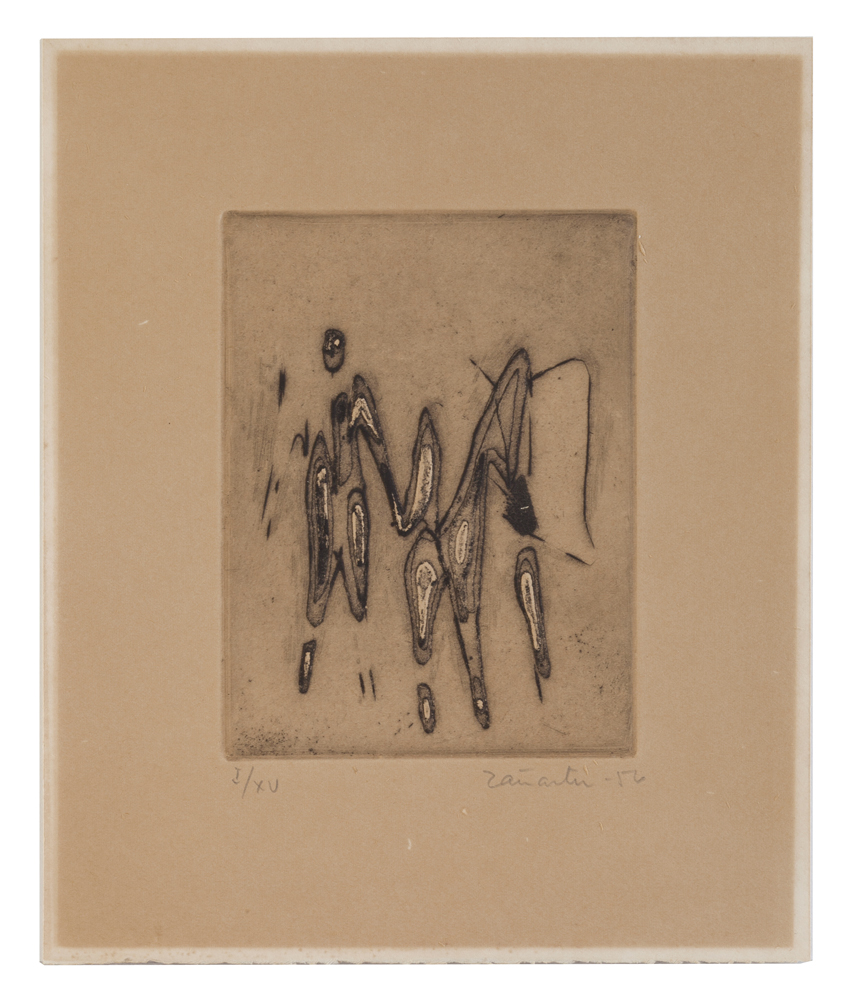
Enrique Zañartu, Untitled, illustrations for Les Indes (The Indies), by Édouard Glissant, 1956. Édouard Glissant’s personal collection. Courtesy of Mémorial ACTe.
Fifty-eight works by twenty-four artists (only two of them women, which tells you something about Glissant’s collecting habits)—now, for the most part, housed in the collection of Mémorial ACTe—are arranged in three galleries. Every time I tried to figure out a curatorial logic, I was thwarted. That’s not to say there aren’t plenty of threads that run through the show, but they, by design, can only be gleaned by moving from one gallery to another. Illustrations for Glissant’s books—Agustín Cárdenas’s for Le discours antillais (Caribbean Discourse), Enrique Zañartu’s for Les Indes (The Indies), Wifredo Lam’s for La terre inquiète (The Restless Earth), and Pancho Quilici’s collage, which appeared on the cover of the novel Tout-Monde (Whole-World)—are hung in different rooms. Landscape—an important concept for Glissant, as it melded land, history, culture, and language outside of definitions of nation-state per se—is visible everywhere, in surrealist, futurist, even video form. This is hardly the only possible trajectory: the female nude, disaster (slavery, sinking ships, war, fire), hybrid figures, collage/assemblage, and so on are all ripe for consideration, along with many other things that haven’t yet occurred to me.
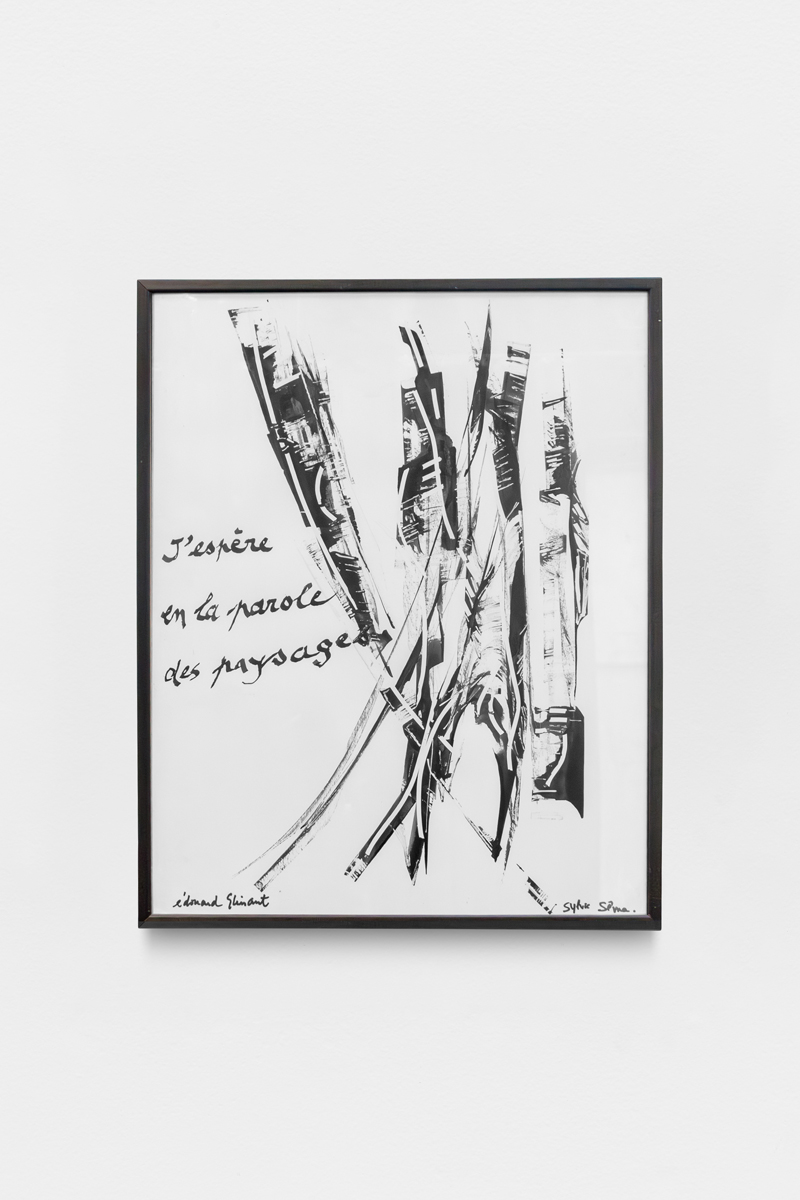
Sylvie Séma Glissant and Édouard Glissant, Untitled, 2003. Ink on paper. Courtesy a private collection.
Relationships are also everywhere—not only Glissant’s relationships with the artists (including his wife, Sylvie Séma Glissant, whose 2003 ink drawings, inscribed with one of Glissant’s poems in his own hand, is included in the show) but also the artists’ with each other. The point is nicely underlined by the inclusion of Melvin Edwards’s welded steel sculpture To Wifredo Lam (1982). And then there are the relationships that occur only through the proximity afforded by the gallery walls, as in the striking juxtaposition of Gerardo Chávez’s untitled oil-on-wood piece from 1978 and Eduardo Zamora’s oil-on-canvas Los amantes 2 (The Lovers 2), from 1987. Chávez was born in Peru and moved to Italy and then Paris in the 1960s at the suggestion of Roberto Matta, where he embarked on works like this one, in which figures with spears appear to have subdued a gigantic body in a chaotic battle. Zamora was born in Mexico, and studied in Kraków before settling in Paris, where he made pictures that melded dreamlike figures in scenes that are both absurd and quotidian, revolving around the depiction of private life.
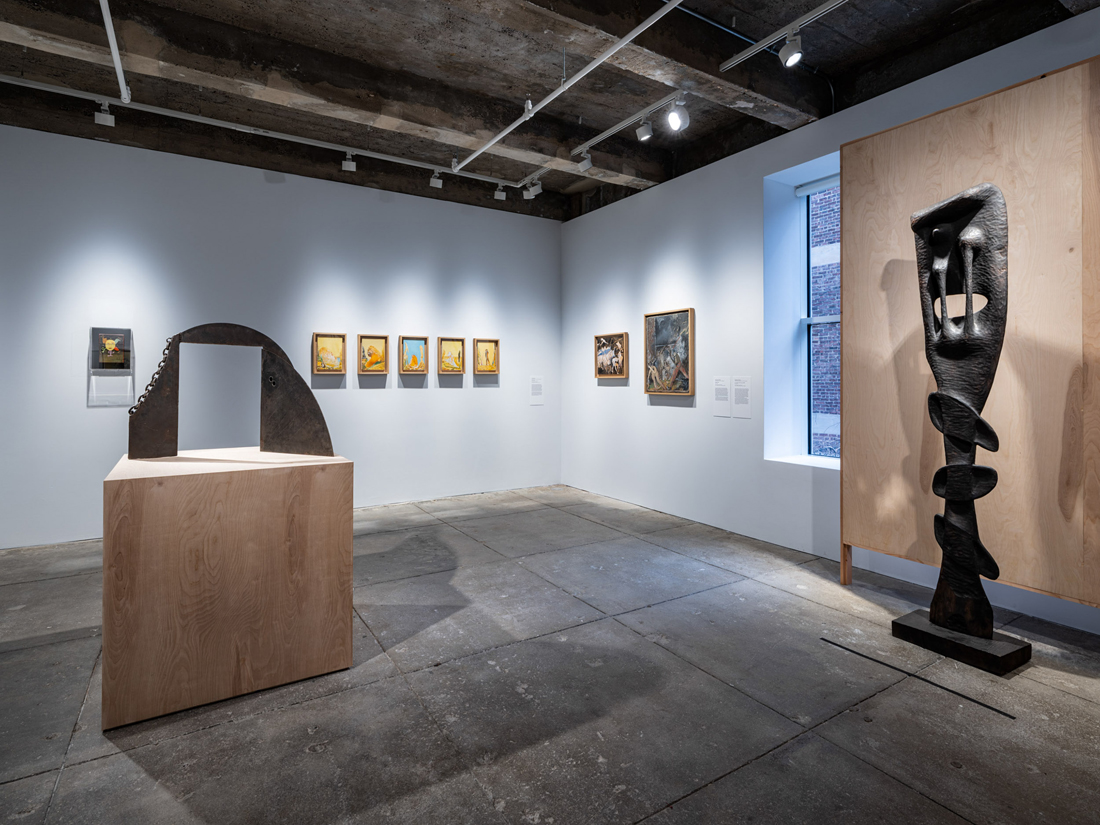
The Earth, the Fire, the Water, and the Winds: For a Museum of Errantry with Édouard Glissant, installation view. Courtesy CARA. Photo: Kris Graves. Pictured, left foreground: Melvin Edwards, To Wifredo Lam, 1982. Center right, on right wall: Gerardo Chávez, Untitled, 1978; and Eduardo Zamora, Los Amantes 2 (The Lovers 2), 1987.
There’s no real reason to hang them together—they were produced in different contexts, at different times, with different subject matter—except for the fact that they look so much alike. Not only because of their portrayals of violence—the male lover in Zamora’s image spews snakes from his mouth and runs at a similarly snake-spewing nude woman with a bat in his hand—but because, too, of their use of dotted and hatched lines, their visual velocity, their palettes. No one pointed this out—it was left for me to discover. And in the discovery, I was able to find new things in the works around me, some of which I embraced (the potential of the dreamlike to speak to the horrors of the present) and some of which I rejected (misogyny), but all of which left me feeling like I understood a little more about the world and its potential than I did before.
Aruna D’Souza is a writer and critic based in New York. She contributes to the New York Times, 4Columns, and Hyperallergic. Her new book, Imperfect Solidarities, was published by Floating Opera Press in 2024.