


 Mark Sinker
Mosh pits and Mexican family drama: Jaime Hernandez’s loving chronicles of two punk-teens and their extended universe in the ’80s and ’90s.
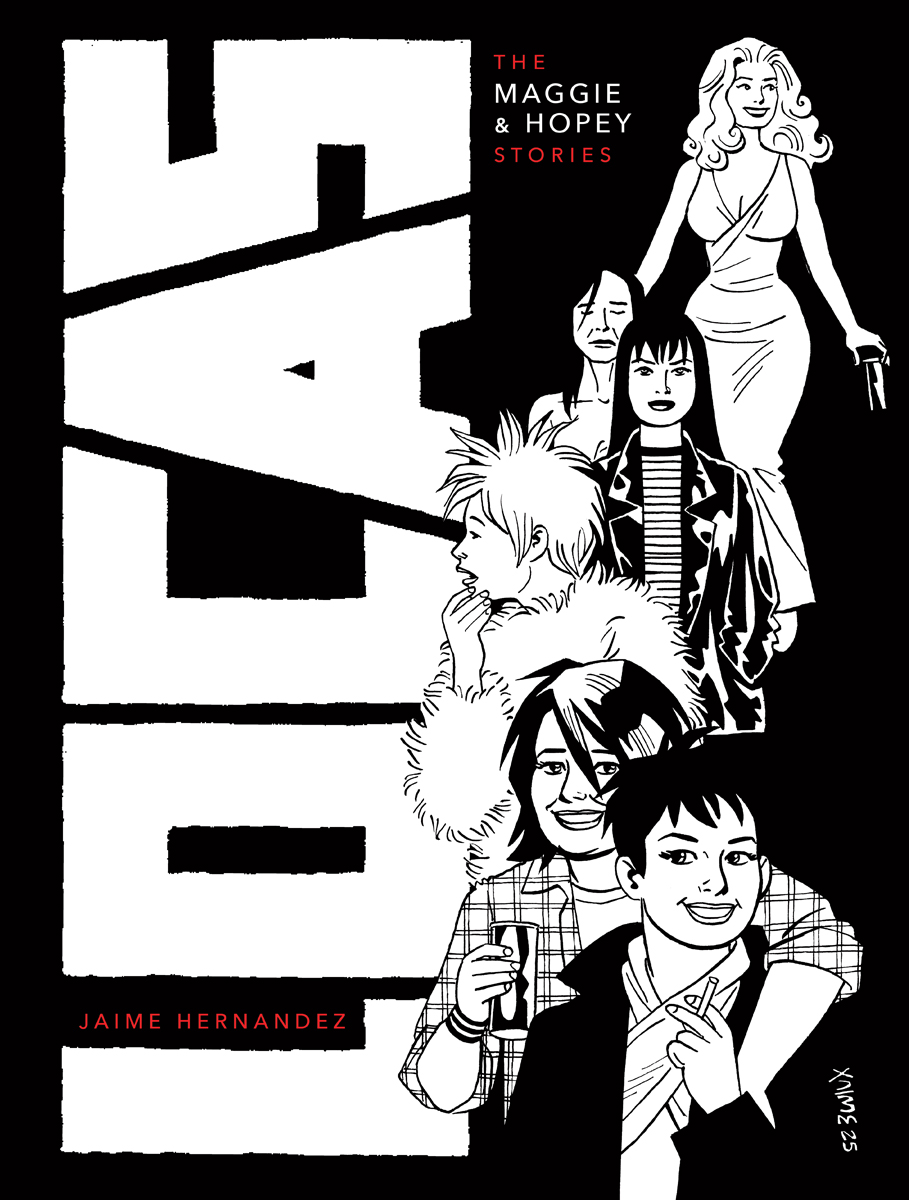
Locas: The Maggie & Hopey Stories, by Jaime Hernandez,
Fantagraphics, 718 pages, $49.99
• • •
There’s a line in a Pere Ubu song that often came to me as I paged through this collection of Jaime Hernandez’s work, following his characters Maggie Chascarrillo and Hopey Glass, two pint-size punker teens from the early ’80s SoCal punk scene: “We can live in the empty spaces of this life . . .”
Love & Rockets is a comic from that same scene, conceived, written, and drawn by the three Hernandez Brothers, Jaime, Gilbert, and Mario. In 1981, its self-published first edition was seized on by publishers Fantagraphics with a yelp of excitement as a DIY return to what comics could and should be. At nearly 720 pages, this deluxe doorstop—Locas: The Maggie & Hopey Stories—represents Jaime’s portion up to the mid-’90s of the brotherly project. Locas means “Crazy Girls,” and the book chronicles modern Chicana life across decades, a loving fictional sketch of women of many ages (and a handful of men) finding routes away from drab squats, boarded-up streets, nagging families, the limits on how others see us.
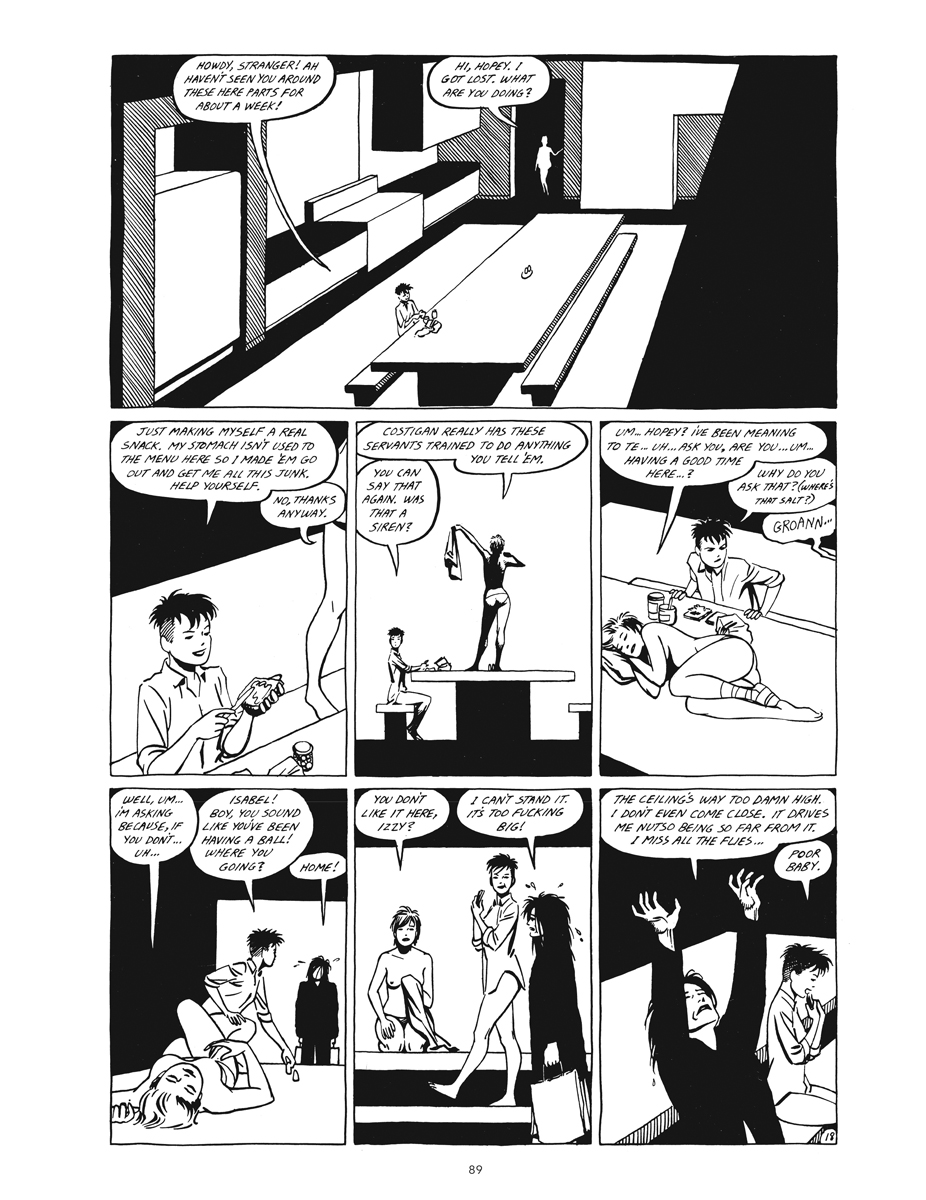
From Locas: The Maggie & Hopey Stories, page 89. Courtesy Fantagraphics.
Vividly talented from the off, Jaime moved swiftly away from clutter and the overwordy storytelling of the opening pages toward a vibrancy of narrative as a Jenga-tower of necessary information: How much can you strip out and still make sense? Clean-line realism with the silly intensity of the exaggerated cartoon expression: angry, startled, horny. Cool precision broken up with all-black pools of ink, dramatic silhouettes, faces lit white in noir lighting, flows of impenetrable troubled evil. Attractive on-page geometries, and then the living curves that subtly trick you into laughing at or with them, and into wanting their company. All comics are just lines on paper: but some of those lines conjure worlds with enormous paracosmic pull.
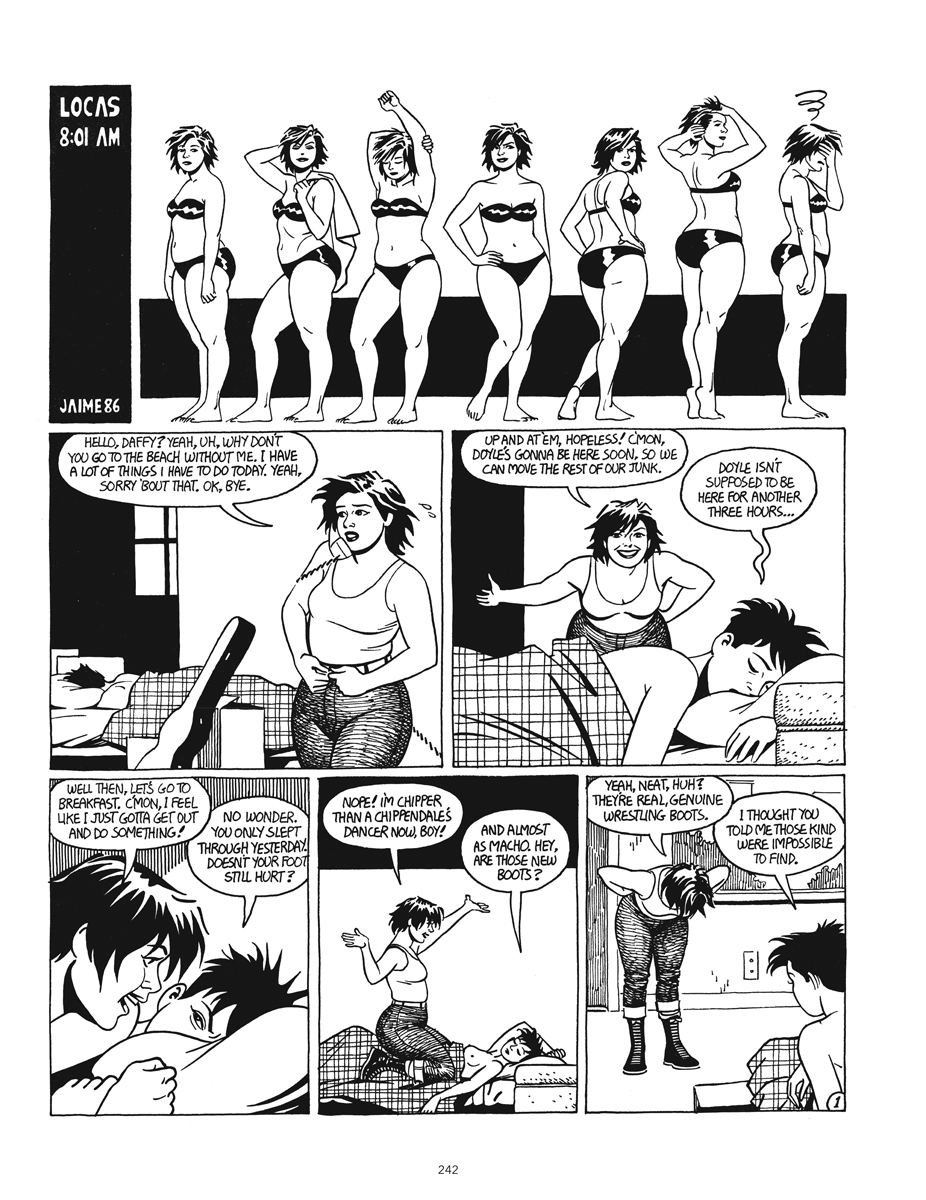
From Locas: The Maggie & Hopey Stories, page 242. Courtesy Fantagraphics.
Early on, Jaime loved to draw robots and rockets, dinosaurs and hover-cars, all the ordinary futuristic apparatus in the titles he’d read as a kid. But his mother, Aurora, the Hernandez family comics scholar, also loved romance comics and classic comics for kids (Archie, Peanuts, the US Dennis the Menace), and Jaime had avidly absorbed these too. At a certain point, he realized the sci-fi was getting in the way of stories where desire and separation matter more than the clatter of fabulous machines or action scenes. What he liked best was drawing girls: most of all Maggie, who worries about boys and yearns to be free of the drudgery of work (as a wrestler’s accountant in a too-tight suit at one point), and perhaps also of the slender prettiness he first trapped her in. Call it the politics of curviness: not only does he know her better as she puts on weight, he visibly enjoys drawing her more. As for her sometime-lover Hopey, that adored skinny firecracker of malicious try-anything glee, no one really unscrambles what’s going on inside her head (so says Hernandez somewhere). So, yes, young cartoon bisexuals (which, make no mistake, was bold agitational fun in comics in the mid-’80s), but they’re punk, too, and this takes us somewhere else again.
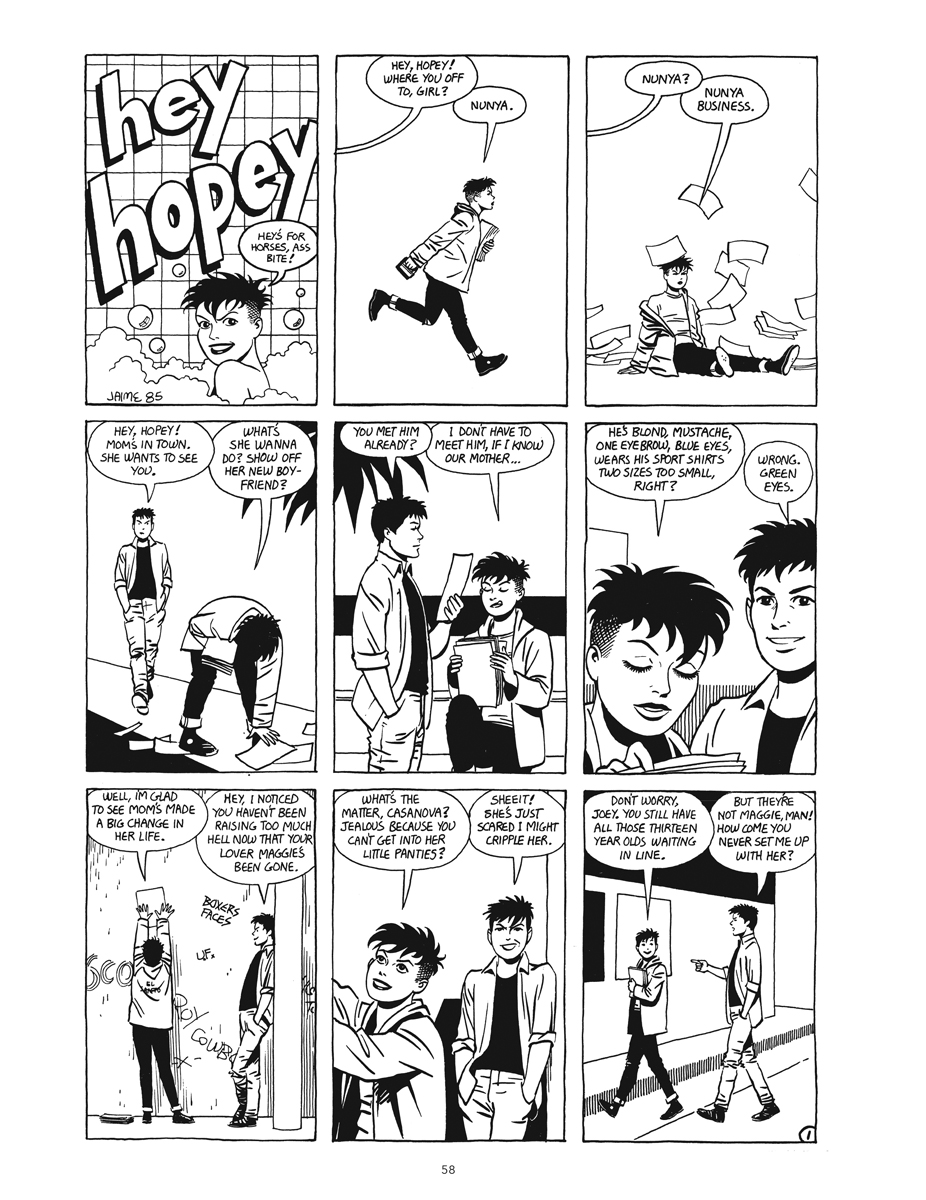
From Locas: The Maggie & Hopey Stories, page 58. Courtesy Fantagraphics.
Because everyone here is navigating the jagged hyphenates and borderlands of class, race, gender, sexuality—a tension of identities, including punk’s idealized reinventions of negative identity. In the trad Mexican family, a girl grows up to marry and be a mother. Then there’s the ferocious style-war battles of local allegiance within Chicano gang life, a counter–pressure valve that can turn lethal. And, in the late ’70s, there was also punk, an improvised kayfabe of gang life with its own rite-of-passage squabbles about its own values and unfreedoms. If you’re young enough, and find the right friends, even silly fake poses can free you from the stupid rules of the adult world.
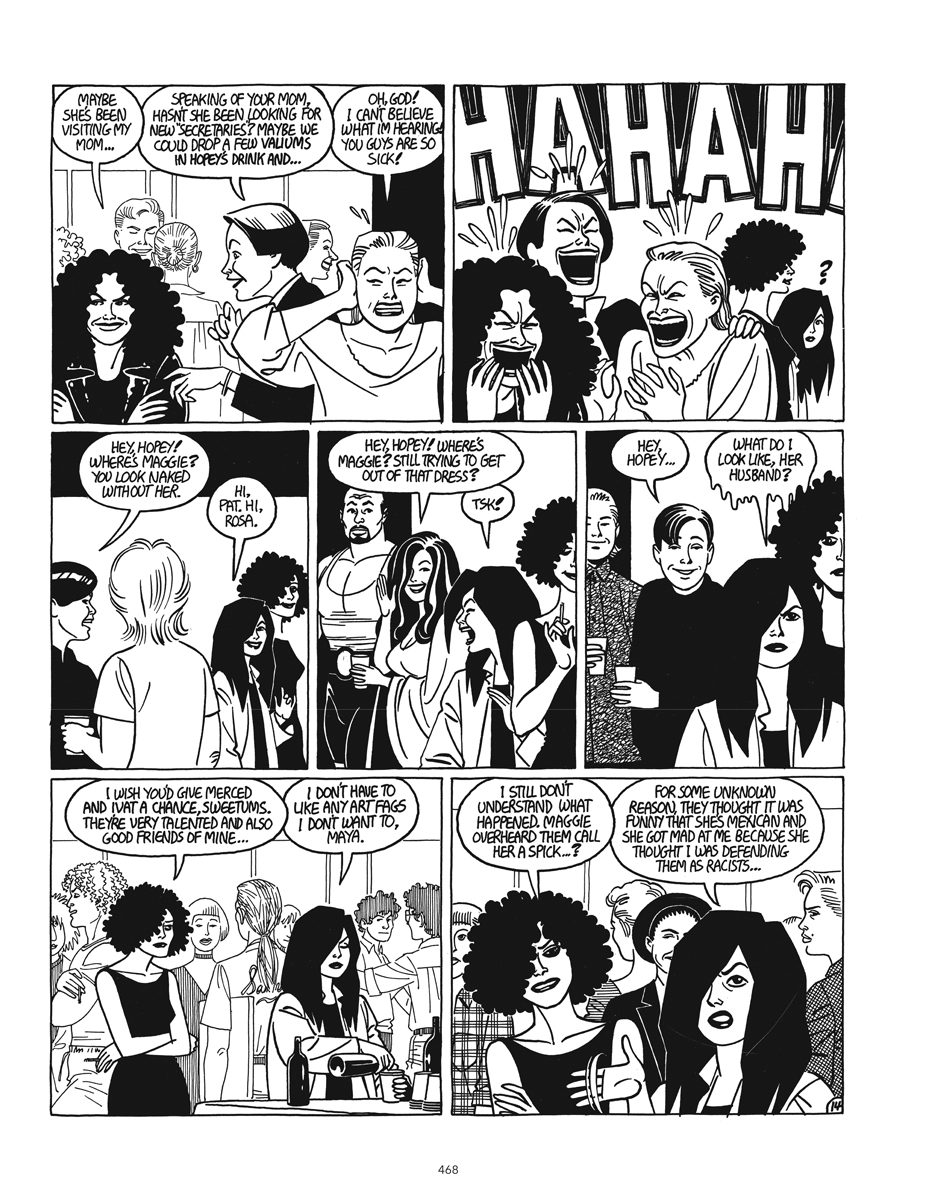
From Locas: The Maggie & Hopey Stories, page 468. Courtesy Fantagraphics.
But once you’re outside these rules, which seem so normie and so cringe, is it even possible to live right? In the hundred-page early ’90s story “Wigwam Bam,” the band Hopey’s on tour with splits up (no surprise), and she finds herself far from Maggie’s anxious kindness, an observer adrift in a hierarchy of who-cares nihilism, scenester pretension and predation. She’s the hot punk kept-girl pet of fecklessly bitchy rich bohemian art-lesbians, which she finds very entertaining—until things turn violent.
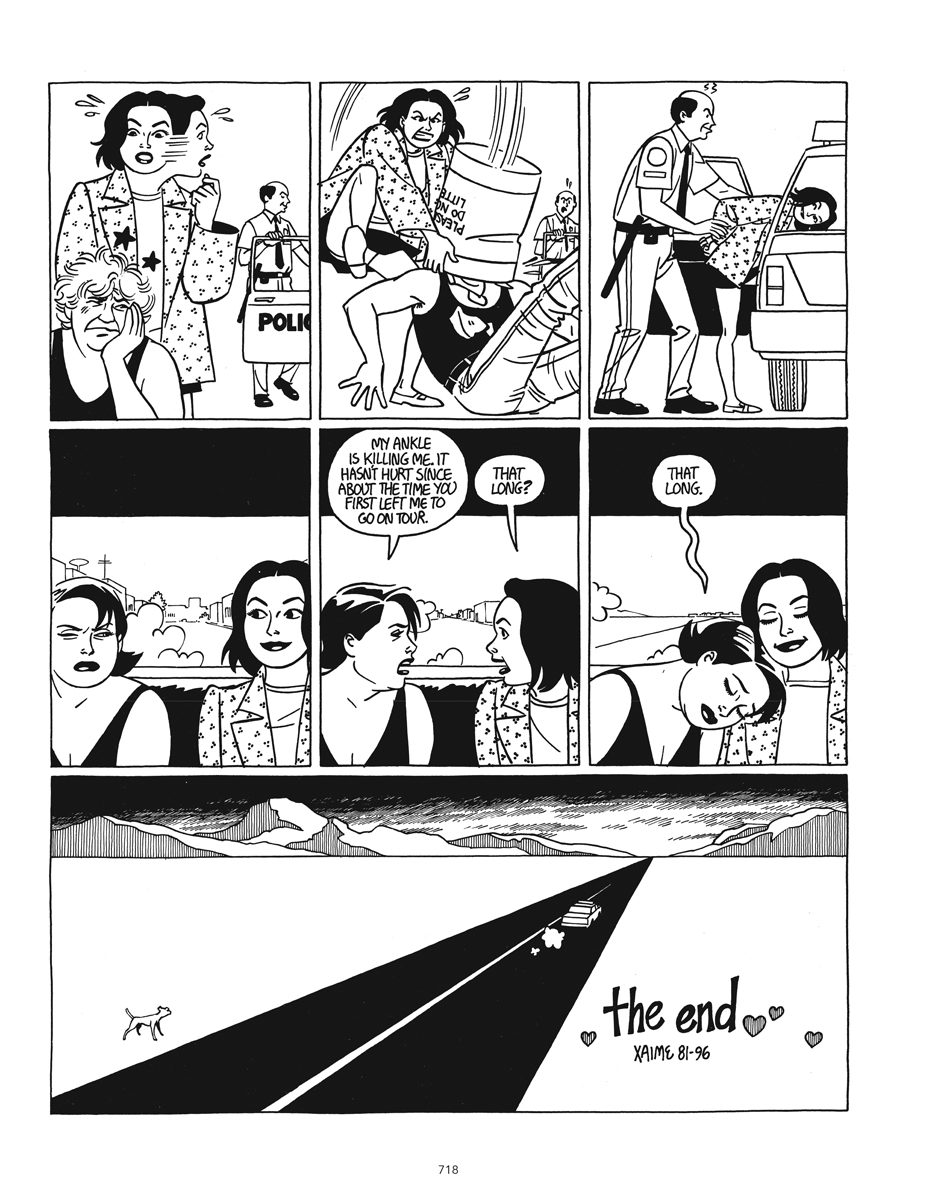
From Locas: The Maggie & Hopey Stories, page 718. Courtesy Fantagraphics.
Locas ends with the reunion of the two heroines (in jail!), but the pair spend far more page-time in the book apart than together. Even in the earliest stories, their coupledom is something they chafe at a little, as a kind of prison of fond legend imposed by friends (and readers). Just eighteen pages deep, we’re in a mosh pit heaving with punks of all shapes: it’s beautifully drawn, but its wildness feels airless and suffocating. On the preceding page, there’s a flashback to two years before: Maggie and Hopey’s meeting as punk-teen high schoolers—if it’s love at first sight, it’s also very fraught.
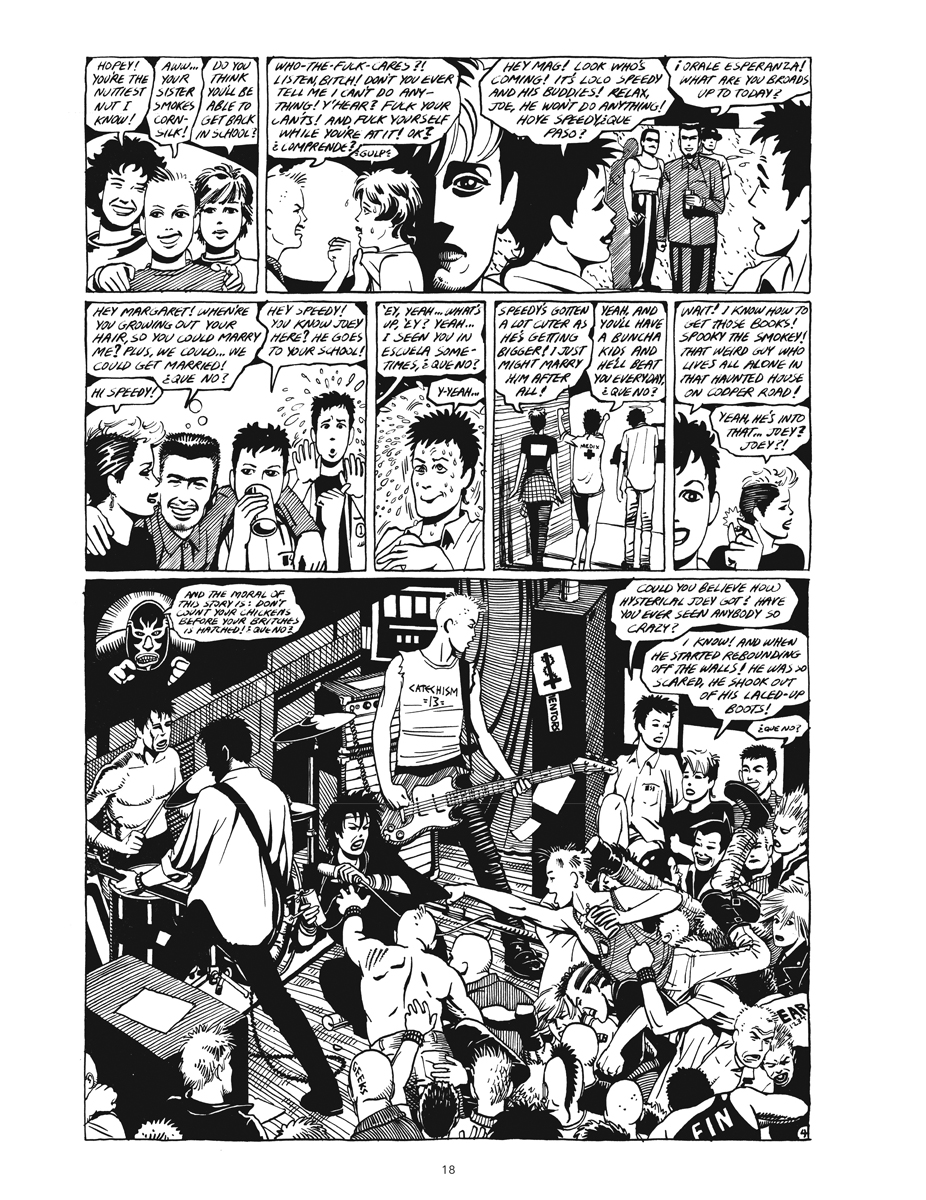
From Locas: The Maggie & Hopey Stories, page 18. Courtesy Fantagraphics.
In the favored mode of realism here, the building block is the flashback, a tale fashioned from many long loops, with newly discovered secrets dropped in as riddles, their decryption undermining what you felt you knew, less like sci-fi than the daft sudden-reveal love-dramas of the realist telenovela—except for this momentum of visual style pulling us ever outward into emptier, freer spaces and unburdened time.
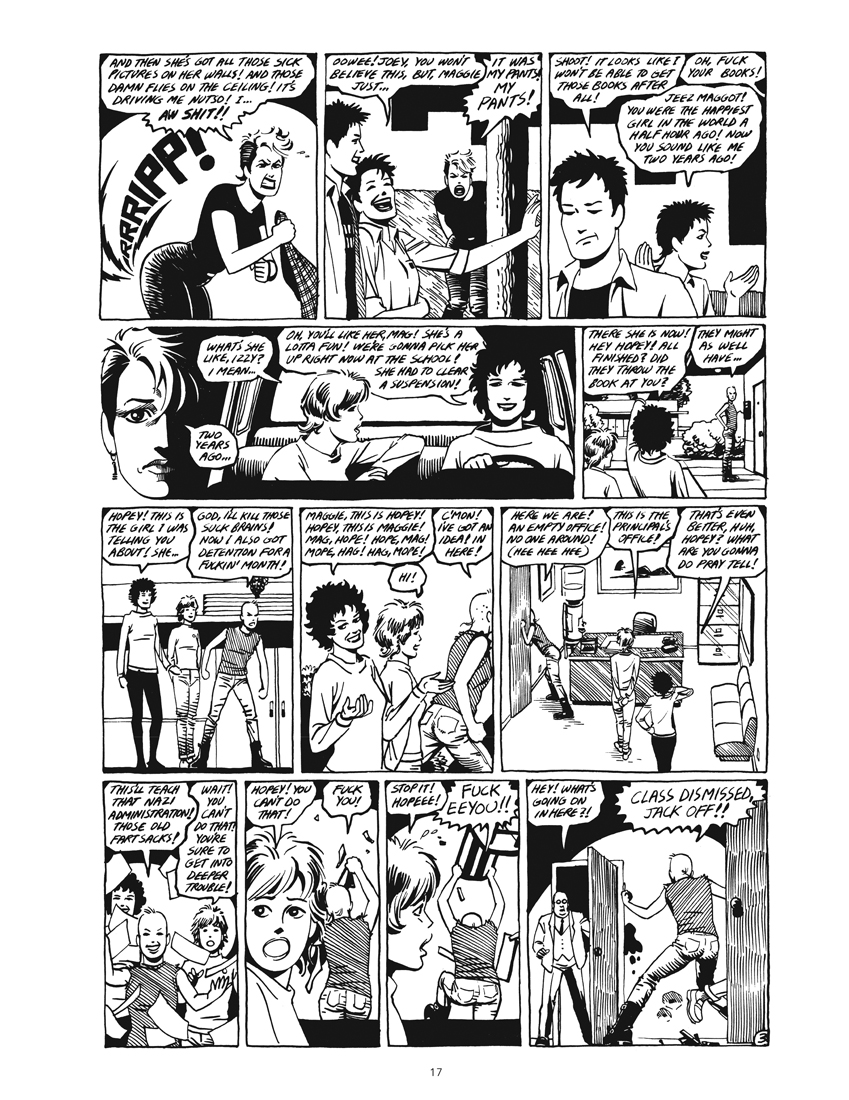
From Locas: The Maggie & Hopey Stories, page 17. Courtesy Fantagraphics.
When Love & Rockets (which continues to publish) first appeared, it was hailed as a kind of post-punk spearhead in a newly energized indie-comics movement, and thus a beachhead against Marvel’s and DC’s corporate cliches. But critical attention mostly veered off behind Alan Moore’s Watchmen, a project wanting it both ways: What if superheroes, but grittily realistic? Jaime’s Locas explores a far wittier direction, deconstructive and perhaps very Mexican, as he traces the links between the performance of girlhood within classic ’70s punk, and women’s wrestling, with its ritualized fake-out battles, glamorous but gruelingly monetized, its tights and cosplay, its caped personas with outsize names, and how the rules just add a layer of knowingly gamed rivalry.
Meanwhile, the people in Locas read comics all the time, as their escape from the mundane: one element in the realism is superheroes whispering at the edges of everyone’s daydreams. It’s even a strand in punk’s old pitch: from a lowly put-upon place we can rewire the universe! But another strand was a profound distrust of the merely aspirational. Marriage into science-fiction levels of money is certainly possible in this story, as a crappy kind of superpower—but no one is surprised when a secondary character achieves it. It’s seen as a manifestation of the daffy craziness she was known for from the start. It’s not that daydreams can’t be the deep root of other, better freedoms—more that the rockets that carry us out into those spaces somehow also always seem to be looping back . . .
Mark Sinker has written about music, film, and the arts since the 1980s, at outlets including Sight and Sound, Crafts magazine, the Face, the Village Voice, and the London Review of Books. In the early 1990s, he was editor of the Wire, and in 2019 published an anthology of essays and conversations about UK music-writing, A Hidden Landscape Once a Week: The Unruly Curiosity of the UK Music Press in the 1960s–80s, in the words of those who were there.